- Multiple lines of evidence photography of the moon landings
- 15,000 photographic slides are available. At least 3 different times they have been scanned by third parties:
- Photographic slides are in a museum in Houston:
- 3 different archives of scans:
- https://tothemoon.im-ldi.com/gallery/apollo/17/6#AS17-148-22727
- https://www.flickr.com/photos/projectapolloarchive/21081863984/
- https://www.lpi.usra.edu/resources/apollo/frame/?AS17-148-22727
- Any accusations of fakery or lying must be accompanied with evidence. The slides are available for analysis. Go ahead, get a photographic forensic analysis expert, book time at the Houston museum to find evidence of fakery. Or use the ASU archives, they include very large non-lossy compressed TIFF files.
- Panorama of Apollo 11 made with these photographs:
- Many third-party republications of the photos in newspapers or magazines in the 1960’s and 1970’s show that these photos are the same photos we have access to today.
- Neil Armstrong walking to the crater
- https://history.nasa.gov/alsj/a11/a11.clsout.html
- Search for “At that large crater”
- The signal was 320 lines of resolution at 10FPS. The conversion for broadcast was essentially a video camera pointing at a high-quality 10-inch (25 cm) TV monitor.
- Neil heading to the crater:
- Neil returning:
- Details of the trip to the crater:
- https://history.nasa.gov/alsj/a11/a11pan1111231.html
- See the collection of frames and the color panorama
- https://history.nasa.gov/alsj/a11/a11.clsout.html
- Photographs of the vehicles left on the moon by third parties
- Lunar Reconnaissance Orbiter Camera
- LRO is not run by, NASA, it’s the University of Arizona and several other organizations:
- See the list
- LROC is a set of cameras mounted on the LRO satellite orbiting the moon between 50 and 200 km
- They have photographed the landing sites multiple times at different times of the lunar day. Notice the footpath to the crater on the Apollo 1 photos.
- https://www.lroc.asu.edu/featured_sites/view_site/1
- https://www.lroc.asu.edu/featured_sites/view_site/2
- https://www.lroc.asu.edu/featured_sites/view_site/3
- https://www.lroc.asu.edu/featured_sites/view_site/4
- https://www.lroc.asu.edu/featured_sites/view_site/5
- https://www.lroc.asu.edu/featured_sites/view_site/6
- LRO is not run by, NASA, it’s the University of Arizona and several other organizations:
- India
- Chandrayaan-2 orbited the moon and took photographs of the surface including some of the Apollo landing sites
- OHRC: Orbiter high resolution camera
- Apollo 11:
- Apollo 12:
- Apollo 14 from Chandrayaan-1:
- Collection of other landing sites:
- Details:
- Lunar Reconnaissance Orbiter Camera
- LRO and India’s space agency are not NASA. They are not subject to NASA oversight. There are large numbers of people in each organization that are involved. Any accusations of fakery or lying must be accompanied with evidence.
Hammer and Feather
- Apollo 15 featured a live video of a hammer and feather dropping. David Scott is 6 feet tall he dropped the hammer and feather from approximately 4 feet or 1.2 meters high.
- The fall took 36 frames in that video.
- Prediction for the moon:
- Moon gravity is 1.625 m / s^2
- Kinematic equation:
- x = v0 * t + 1/2 * a* t^2
- x is height
- v0 = 0
- x = 1/2 * a * t^2
- Solve for t
- 2 * x / a = t^2
- t = sqrt(2 * x / a)
- t = 1.215 seconds
- Prediction for the earth
- Earth gravity is 9.8 m/s^2
- Applying the same kinematic equation: 0.495 seconds
- Measurement of the the time to fall:
- Frame rate of that video is 29.97 FPS
- To get the time to drop divide the frames by the frame rate:
- 36 / 29.97 = 1.201201201 seconds
- Prediction for moon matches live demonstration
All calculations: https://onlinegdb.com/IjCazg0rQ
Independent Audio Recordings

The Apollo craft on the moon transmitted real time radio communication to earth. Some people received these radio transmissions with homemade antennas or large dishes. Some were recorded.
The antennas had to be aimed at the moon to receive a signal, when not pointed at the moon there was no signal. This disproves any claims about non-lunar sourced transmissions as there is no way to transmit from this position using terrestrial or orbiting sources.
The recordings have just one side of the communication: the astronauts on the moon. The transmissions from the NASA control room are not present, as expected.
- Larry Baysinger
- In July 1969 Larry Baysinger built a homemade radio antenna to receive the transmissions from the moon. Local reporter Glenn Rutherford was present and recorded the audio. They recorded 35 minutes of audio including walking around on the moon.
- 1969 article: http://observatory.jctcfaculty.org/APOLLO11/HiResImages/RutherfordArticle.gif
- Archive link: Newspaper article from 1969
- 2009 article: National Association of Amateur Radio article on the event
- Archive link: LUNAR EAVESDROPPING IN LOUISVILLE, KENTUCKY
- 2019 article: https://www.courier-journal.com/story/news/2019/07/19/apollo-11-moon-landing-louisville-man-eavesdropped-mission-1969/1743648001/
- Recording of Apollo 11 moon walk: https://mctoon.net/wp-content/uploads/2025/11/apollo-11-baysinger-1969.wma_.zip
- My conversion of WMA file to MP3: https://mctoon.net/wp-content/uploads/2025/11/apollo-11-baysinger-1969.mp3
- Bochum Observatory
- This observatory in West Germany used their 20 meter telescope to record the descent and landing of Apollo 11. This includes the iconic phrase “The Eagle has landed”.
- The audio on this page has dual audio:
- The right channel is recorded at Bochum Observatory. Contains only the lunar transmissions.
- The left channel has audio recorded at Honeysuckle, but coming from Goldstone. Contains the responses from CAPCOM.
- https://honeysucklecreek.net/other_stations/bochum/index.html
Photo processing
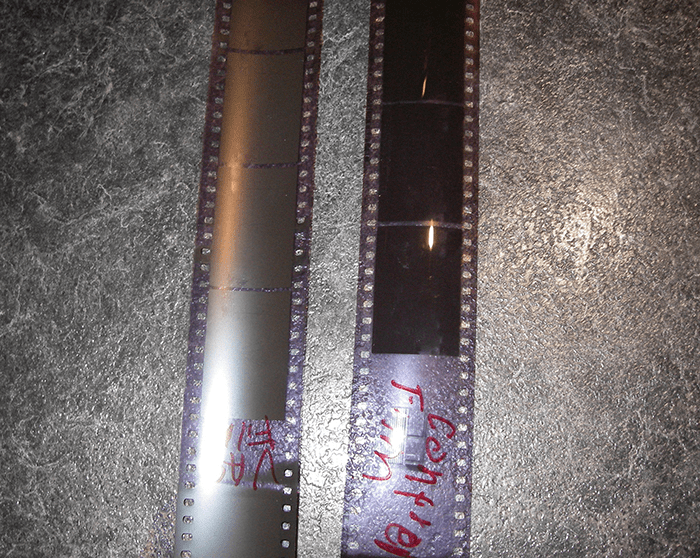
The “Apollo Detectives”, moon landing hoaxers, tried testing film in vacuum but had several problems:
- They didn’t use the same film Apollo 11 color film was SO-368, ‘SO’ standing for ‘Special Order’.
- The developing process in 1969-1972 was either E-3 or E-4. Apollo Detectives didn’t use this process.
- Apollo Detectives put a spotlight on the film to heat it up, but the canisters used in the Apollo missions were in a reflective canister that wouldn’t get that hot.
- Apollo Detectives put the film under vacuum for 3 days. The Apollo missions did not subject the film to that long of a vacuum. The extreme low pressure was mostly limited to the time on the moon during the EVAs.
- The development process is briefly describes in Apollo documentation. See pages 117-120.
- “A test section from the beginning of every roll of film is given a series of precisely controlled exposures, each consisting of an exact quantity of light of a specific color. After the film is used and processed, scientific measurements of these test exposures, known in the trade as sensitometric strips, are compared with standards to determine any existing variations.”
- “After it has been reassembled and the chemicals prepared, samples of the type of film from the same roll used on the mission, again with the test exposures or sensitometric strips, are processed so that the chemicals and equipment are at predetermined optimum operation. Such test strips are processed and evaluated immediately before space film is processed, the procedure being repeated at frequent periodic intervals to insure the continued stability of the chemical solutions.”
- Apollo Detectives did not replicate this process.
- Apollo detectives proved that the film works in longer vacuum and under higher temperatures than Apollo film was subject to. Thanks! The color balance was different which can be easily adjusted using the sensitometric strips in the Apollo film that the Apollo Detectives did not perform.
- The Apollo Detectives destroy any remaining credibility with the photo below where they show the vacuum and heat processed on the left and the “control film” on the right. They show the emulsion side of the vacuum treated film and the substrate side of the film for the “control”. The emulsion side is always duller and a different color. No serious researcher would make a mistake like this. This is intentional.
Camera Usage
Focus
There were 3 focus settings: near, mid, far.
Aperture
Aperture was f5.6, f8, or f11 for shadow, mid, and light.
Shutter Speed
Shutter speed was either 1/250 or 1/125
Misc links:
Restored video from source tapes:
https://www.nasa.gov/multimedia/hd/apollo11_hdpage.html
Photo archives:
https://www.flickr.com/photos/projectapolloarchive/21514900220/
http://tothemoon.ser.asu.edu/gallery/Apollo/12/Hasselblad%20500EL%2070%20mm#AS12-50-7348
https://www.lpi.usra.edu/resources/apollo/frame/?AS12-50-7348
https://catalog.archives.gov/id/16689986
Want to examine them yourself? You can personally visit the archives: https://historycollection.jsc.nasa.gov/JSCHistoryPortal/history/history_collection/uhcl.htm
Telemetry data:
Apollo 15 Personal Life Support System Telemetry data: https://ntrs.nasa.gov/api/citations/20160014527/downloads/20160014527.pdf
- Astronaut Battery current and voltage
- Water Delta temperature
- Gas outlet temperature
- Feedwater perssure
- Oxygen supply pressure
- Carbon dioxide partial pressure
- Inlet temperature
Apollo 12 Dust Detector telemetry: https://ntrs.nasa.gov/api/citations/20120009885/downloads/20120009885.pdf
Include a graph showing when the Lunar Module took off and, blowing the accumulated dust off the solar cell, then the output increased as the sun angle rose higher in the sky.
Apollo 17 LEAM telemetry data analysis: http://dx.doi.org/10.1016/j.pss.2013.10.005
Direct PDF download:
Archive of assorted Apollo Telemetry data and analysis: https://pds-geosciences.wustl.edu/missions/apollo/index.htm
Did NASA fake photos of the missions?
No.
http://www.moonhoaxdebunked.com/2017/07/522-how-come-eva-photo-of-michael.html
Did Buzz Aldrin say that everything was an animation?
No, just the live televised step-by-step artist’s rendition, which was never claimed to be real, it was always labeled as an artist’s rendition: https://youtu.be/FlpstXNjImY?t=948
This is the live broadcast from the moon as they exited the LEM: https://youtu.be/iR3oXFFISI0?t=1062
Were the Apollo 11 astronauts so distraught during a news conference?
No, it was over an hour long and there were times of listening and times of joking: https://youtu.be/BI_ZehPOMwI?t=529
Did NASA say they cannot go through the Van Allen belts?
No, NASA said the radiation could affect the Orion spacecraft if it is not properly shielded. Shielding solutions must be engineered and tested before trusting the systems with human lives. https://youtu.be/KyZqSWWKmHQ?t=180
“Radiation like this can harm the guidance systems, onboard computers, or other electronics on Orion.”
“But Orion has protection, shielding will be put to the test as the vehicle cuts through the waves of radiation.”
It’s clear they are not saying they cannot do this, they are saying they must test the systems to ensure the systems work.
Protecting electronics from the effects of radiation
Radiation Effects and Soft Errors in Integrated Circuits and Electronic Devices
Total Ionizing Dose Hardened and Mitigation Strategies in Deep Submicrometer CMOS and Beyond
There is high-quality photography of the Apollo landing sites showing the lander, the experiments that were left, and the footprints.
https://www.nasa.gov/mission_pages/LRO/news/apollo-sites.html
https://www.nasa.gov/mission_pages/apollo/revisited/index.html
http://www.lroc.asu.edu/featured_sites/
Just for fun, here is an interactive transcript:
https://history.nasa.gov/afj/ap13fj/03tde.html
What about seeing the stars in photos or videos?
This covers some: https://www.youtube.com/watch?v=9mpt9CC-i_Q
Earth and Venus: https://www.flickr.com/photos/projectapolloarchive/21692804531
Again: https://www.flickr.com/photos/projectapolloarchive/21699248575
Some photos taken on the moon that have stars:
https://tothemoon.im-ldi.com/gallery/apollo/16/7#AS16-106-17408
Russia landed 2 rovers on the moon, one travelled 39km and the tracks have been photographed: https://lroc.im-ldi.com/images/774
 MCToon