Just like Flatzoid, Nathan of the Clan MuteButton, has a list of citations that he references for celestial navigation. Do they all affirm the earth is a globe? Find out below.
Note: Oakley’s list generally do not include links, I have done the work for him and included the links.
The altitude angle (sometimes referred to as the “solar elevation angle”) describes how high the sun appears in the sky. The angle is measured between an imaginary line between the observer and the sun and the horizontal plane the observer is standing on.
Sustainable By Design :: Altitude Angle
This is from a web site that has an online calculator to determine the angular elevation (called altitude angle on the sire) of the sun. The site is designed as an aid to people calculating the output from solar panels. Not a celestial navigation instructional site. Nathan is playing semantics games by suggesting that the author intends the description prescriptive while simultaneously the formula provided is based on the geometry of the globe. Screenshot below.
First Law of Flerf number 1.

The elevation angle (used interchangeably with altitude angle) is the angular height of the sun in the sky measured from the horizontal
Elevation Angle | PVEducation
Nathan is certainly hoping that nobody searched for this page. It has an excellent diagram describing elevation angles on the globe:

First Law of Flerf number 2.
Measurement of the elevation angle
Elevation Angle – Radartutorial
“Elevation angle is the angle between the horizontal plane and the line of sight, measured in the vertical plane. The reference direction (i.e. an elevation angle of zero degrees) is a horizontal line in the direction to the horizon”
This is a web site with information about radar. Not a celestial navigation instructional site. More semantics games by Nathan. Also his citation has this little gem:
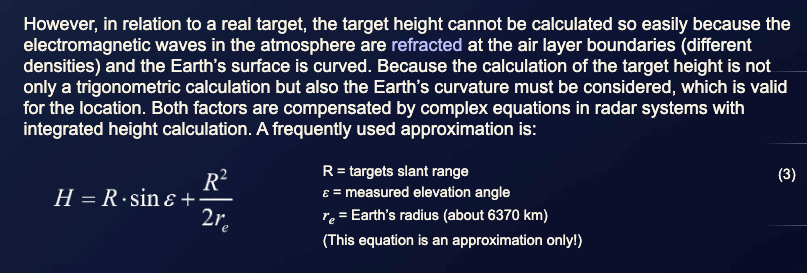
And a little additional treat:

First Law of Flerf number 3.
The solar zenith angle is the angle between the sun’s rays and the vertical direction. It is closely related to the solar altitude angle, which is the angle between the sun’s rays and a horizontal plane Since these two angles are complementary, the cosine of either one of them equals the sine of the other.
No citation provided
There are a few sites that include the same text exactly as Nathan provided. This is just another semantics game. Nathan, do you have any citations from celestial navigation instructional sources?
The angle of elevation is the angle between the horizontal line and the line of sight which is above the horizontal [not curved] line. It is formed when an observer looks upwards. Suppose you are standing at the terrace of a building and looking upwards at the sky or at the sun or moon. The angle thus formed between your height from the ground level and the line of sight formed is called the angle of elevation.
Angle of Elevation – Formula, Definition, Examples
Yet another site that is not about celestial navigation. This is a tutorial for children introducing trigonometry to solve triangles. Nathan wants people to think that triangles like this are used in celestial navigation. But, Nathan doesn’t understand the topic enough to realize that if you did use a triangle, it would requiring know the height of the celestial objects over the flat earth dirt pizza. But, every time this is tried, the elevations never work and you get different elevations for different observers simultaneously.
This falsifies flat earth. First Law of Flerf number 4.
Also note that “[not curved]” was added by Nathan. It’s not in the original text.

The angle of elevation is an angle that is formed between the horizontal line and the line of sight. If the line of sight is upward from the horizontal line, then the angle formed is an angle of elevation.
Angle of Elevation – Definition, Formula and Examples
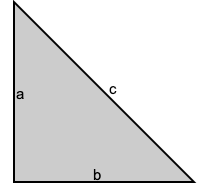
Yet another tutorial for children introducing using trig to solve triangles. Nathan, when you solve a triangle, you know the lengths of all the sides.
Solve this triangle Nathan, On the equinox at 45°N latitude I measured the sun to be 45° elevation at zenith. At 45°N latitude I am 2700nm from the equator where the GP of the sun is. Presuming your dirt pizza, what are the lengths of all the sides?
Now solve this one: on the same day my friend measured the sun to be at 60° elevation at zenith. At 30°N latitude he is 1800nm from the equator. What are the lengths of all the sides.
Nathan, you really want to use triangles. But when you do, something goes wrong.
This falsifies flat earth. First Law of Flerf number 5.
“The “upwards” angle from the horizontal to a line of sight from the observer to some point of interest.” – Definition of Angle of Elevation
Angle of Elevation
Definition
“An angle of elevation is an angle with one horizontal arm, and one arm above horizontal.
Usually an angle of elevation is less than or equal to 90°.” – Angle of Elevation
Globe Defender “I’ve Used A Flat Plane” #shorts https://youtu.be/giHZ84glrHU via @YouTube as detailed here 😆
” Elevation Angle is the angle between the HORIZONTAL PLANE and the LINE OF SIGHT, measured in the vertical plane.”
https://www.radartutorial.eu/01.basics/Measurement%20of%20the%20elevation%20angle.en.html#:~:text=elevation%20angle%20%CE%B5-,Measurement%20of%20the%20elevation%20angle,horizon%2C%20starting%20from%20the%20antenna.
iGCSE (2021 Edition) 16.02 ‘Angles of ELEVATION’ and depression:
“An ‘ANGLE OF ELEVATION’ is the angle from the lower object to the higher one, while an angle of depression is the angle from the higher object to the lower one. Both angles are measured with respect to the ‘HORIZONTAL PLANE’ of the reference object.”
https://mathspace.co/textbooks/syllabuses/Syllabus-1081/topics/Topic-21052/subtopics/Subtopic-273078/
“The ‘ANGLE OF ELEVATION’ is a widely used concept related to height and distance, especially in trigonometry. It is defined as ‘AN ANGLE BETWEEN THE HORIZONTAL PLANE’ and oblique line from the observer’s eye to some object above his eye.”
https://byjus.com/maths/angle-of-elevation/
The ‘ALTITUDE ANGLE’ (sometimes referred to as the “solar ‘ELEVATION ANGLE’) describes how high the sun appears in the sky. The angle is measured between an imaginary line between the observer and the sun and ‘THE HORIZONTAL PLANE THE OBSERVER IS STANDING ON’.
https://susdesign.com/popups/sunposition/altitude.php
“The Solar Altitude (αs) measures the angle between the central ray from the Sun (beam radiation), and a ‘HORIZONTAL PLANE CONTAINING THE OBSERVER’.”
https://www.e-education.psu.edu/eme810/node/485
” ‘ALTITUDE ANGLE’ is the vertical angle between the projection of sun’s rays on the ‘HORIZONTAL PLANE OF EARTH’S SURFACE’.”
https://mcqs.tasdia.com/mcqs/explanation/altitude-angle-is-the/26748
“Target ‘ELEVATION.ANGLE’ between ‘THE HORIZONTAL PLANE’ and the line of sight, measured in the vertical plane through the line of sight. Positive angles are measured upward ‘FROM THE HORIZONTAL PLANE’ .”
PRINCIPLES OF NAVAL ORDNANCE AND GUNNERY pg. 514
https://books.google.com/books?id=f0NUfGDwusgC&pg=PA514&lpg=PA514&dq=Elevation+Angle+horizontal+plane&source=bl&ots=LYOfu5CgOQ&sig=ACfU3U1aHltuno3Y7GuVCeGQrr0yB-_sAg&hl=en&sa=X&ved=2ahUKEwj9wMqPiJL5AhU1kWoFHbzvCH04ZBDoAXoECAMQAw#v=onepage&q=Elevation%20Angle%20horizontal%20plane&f=false

 MCToon